Parikh's Rule: Calculating Due Dates for Irregular Menstrual Cycles

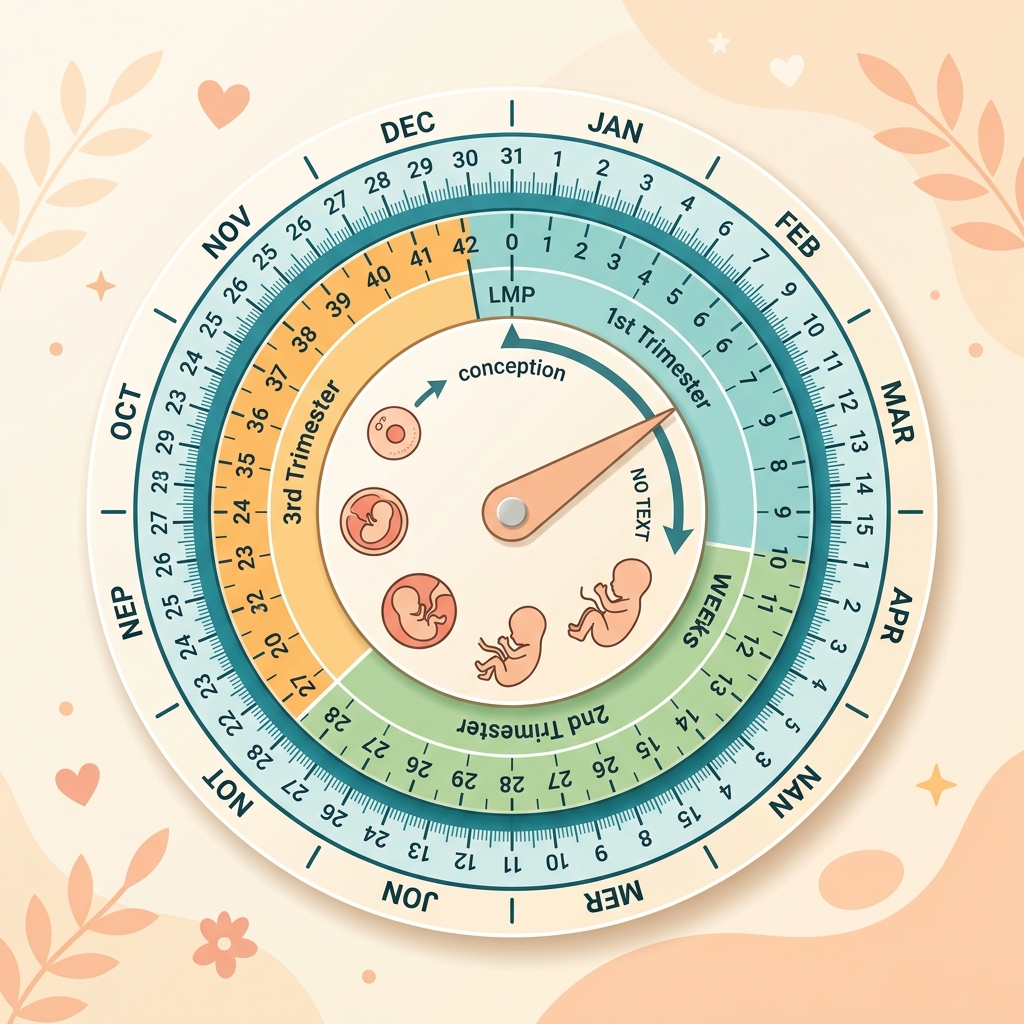
When it comes to pregnancy calculators, almost all of them run on the same default assumption: your menstrual cycle is exactly 28 days long, and you ovulate precisely on day 14. This formula, known as Naegele’s Rule, is the engine behind traditional cardboard obstetric wheels and many standard online calculators.
But what if your cycle is 35 days? Or 24 days? Or completely irregular?
For millions of women, a 28-day cycle is the exception, not the rule. If you rely on standard due date calculators with a longer or shorter cycle, your Estimated Due Date (EDD) could be off by a week or more. To solve this, obstetricians use an adjusted calculation known as Parikh’s Rule.
In this comprehensive guide, we will explore Parikh’s Rule, explain the mathematics behind it, compare it to Naegele’s Rule, and show you how to calculate an accurate due date if you have irregular periods.
The Flaw in Standard Due Date Calculations
To understand why Parikh’s Rule is necessary, we must look at how the standard due date formula is built. As discussed in our baseline guide, Understanding the OB Wheel & Naegele’s Rule, the standard pregnancy duration is defined as 280 days (40 weeks) from the first day of your Last Menstrual Period (LMP).
This 280-day baseline is derived from: $$\text{Days from LMP to Ovulation (14 days)} + \text{Days from Ovulation to Birth (266 days)} = 280\text{ days}$$
This formula works perfectly only if the luteal phase (post-ovulation) is 14 days and the follicular phase (pre-ovulation) is also 14 days.
However, medical studies show that while the luteal phase remains relatively constant at 14 days for most women, the follicular phase varies widely.
- If you have a 35-day cycle, you do not ovulate on day 14. You likely ovulate on day 21 (35 - 14 = 21).
- If you have a 24-day cycle, you likely ovulate on day 10 (24 - 14 = 10).
If a standard calculator is used for a woman with a 35-day cycle, it will calculate her due date as if she ovulated 7 days earlier than she actually did. This artificial shift makes the pregnancy appear 7 days older than its true biological age, which can lead to complications later, such as premature induction of labor.
What is Parikh’s Rule?
Parikh’s Rule is a clinical modification of Naegele’s Rule proposed to adjust for variations in menstrual cycle length. It prevents dating errors by incorporating your actual cycle duration into the formula.
The rule is named after Dr. Parikh, who formulated it to reduce the rate of misdated pregnancies in clinics.
The Parikh’s Rule Formula
To calculate the Estimated Due Date (EDD) using Parikh’s Rule, you use the following formula: $$\text{EDD} = \text{LMP} + 280\text{ days} + (\text{Cycle Length} - 28\text{ days})$$
Alternatively, you can think of it as a step-by-step calculation:
- Calculate the standard due date using Naegele’s Rule (LMP + 280 days).
- Determine the difference between your average cycle length and 28 days.
- Add or subtract that difference to/from your standard due date.
Step-by-Step Calculation Examples
Let’s look at how Parikh’s Rule performs in real-world scenarios.
Example 1: A Longer Cycle (35 Days)
Suppose the first day of your LMP was April 1, 2026, and your average cycle length is 35 days.
- Standard Naegele’s Calculation:
- April 1 + 280 Days = January 6, 2027
- Apply Cycle Adjustment:
- Cycle length = 35 days.
- Adjustment = $35 - 28 = +7\text{ days}$.
- Calculate Adjusted EDD:
- January 6, 2027 + 7 Days = January 13, 2027
By adjusting for the longer cycle, we prevent the baby from being misdiagnosed as “overdue” during the 40th week of pregnancy, as the biological conception occurred a week later than standard formulas assume.
Example 2: A Shorter Cycle (24 Days)
Suppose the first day of your LMP was April 1, 2026, and your average cycle length is 24 days.
- Standard Naegele’s Calculation:
- April 1 + 280 Days = January 6, 2027
- Apply Cycle Adjustment:
- Cycle length = 24 days.
- Adjustment = $24 - 28 = -4\text{ days}$.
- Calculate Adjusted EDD:
- January 6, 2027 - 4 Days = January 2, 2027
In this case, the baby is expected 4 days earlier because ovulation occurred sooner in the cycle.
Naegele’s Rule vs. Parikh’s Rule Comparison
To see the difference at a glance, here is a comparison table outlining how both rules approach pregnancy dating:
| Feature | Naegele’s Rule | Parikh’s Rule |
|---|---|---|
| Cycle Length Assumption | Rigidly 28 days | Variable (e.g., 20 to 45 days) |
| Ovulation Day Assumption | Day 14 | Cycle Length minus 14 |
| Primary Formula | $\text{LMP} + 280\text{ days}$ | $\text{LMP} + 280\text{ days} + (\text{Cycle Length} - 28)$ |
| Clinical Use Case | Regular, standard 28-day cycles | Shorter, longer, or consistently non-28 day cycles |
| Induction Risk | Higher risk of early induction for long cycles | Lower risk due to corrected dating |
Our online OB Wheel Calculator includes cycle length customization, meaning it automatically applies Parikh’s Rule calculations when you enter a cycle length other than 28 days.
What if Your Cycles Are Completely Irregular?
Parikh’s Rule is highly reliable if your cycles are consistent (e.g., always 32 days, or always 25 days). But what if your periods are unpredictable, varying from 21 to 45 days month-to-month?
If your cycles are highly irregular:
- Parikh’s Rule is Less Reliable: Since you cannot predict which cycle length applies to the conception month, calculating by LMP remains highly uncertain.
- Clinical Dating shifts to Ultrasound: Your healthcare provider will rely heavily on an early first-trimester ultrasound (dating scan) to measure the embryo’s Crown-Rump Length (CRL). This physical measurement bypasses menstrual history entirely. To understand how clinics reconcile ultrasound findings with period dates, check out our guide on Ultrasound Dating vs. LMP.
- Basal Body Temperature or Ovulation Strips: If you were tracking ovulation using temperature charts, cervical mucus, or luteinizing hormone (LH) test kits, you can use the ovulation date as the starting line. You would simply add 266 days to your ovulation date to find your due date.
Conclusion
Every pregnancy is unique, and so is every woman’s menstrual cycle. Using a one-size-fits-all approach to pregnancy due date calculation can lead to stress, incorrect assumptions about developmental milestones, and clinical missteps.
By utilizing Parikh’s Rule, you can align your calculations with your body’s biological rhythm. If your cycle is consistently shorter or longer than 28 days, make sure to use a customizable calculator to find a more accurate representation of your due date, and share this information with your midwife or OB-GYN at your first prenatal appointment!
Written by Dr. Sarah Jenkins, OB-GYN
Dr. Sarah Jenkins is an experienced Obstetrician-Gynecologist dedicated to helping women navigate their pregnancy journeys with clinical clarity, evidence-based practices, and compassionate support.
Expert Reviewed & Fact Checked