Ultrasound Dating vs. LMP: How Doctors Establish Your Final Pregnancy Due Date

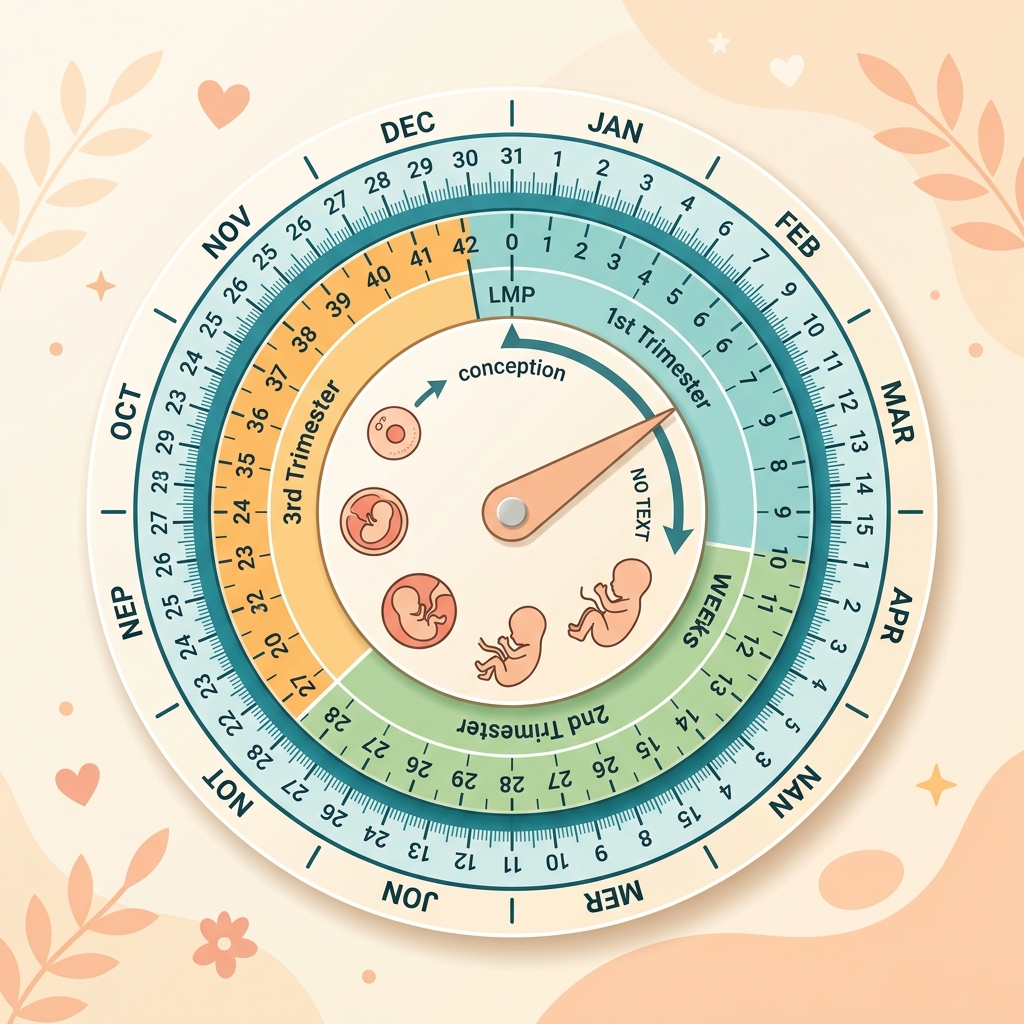
At your first prenatal visit, your doctor or midwife will write down two dates: one based on your Last Menstrual Period (LMP) and another based on an early ultrasound. Often, these two dates do not match. You might calculate one due date using an online OB Wheel calculator, only to have your doctor adjust it by four or five days during your scan.
This discrepancy can lead to confusion. Which date is correct? Why did the due date change? How accurate are ultrasounds compared to calendar dates?
In the medical community, reconciling the difference between LMP-based dating and ultrasound dating is a standardized clinical protocol. In this guide, we will analyze the science behind Ultrasound Dating vs. LMP, review the accuracy margins of early scans, explain Crown-Rump Length (CRL), and detail the guidelines doctors use to establish your final, official Estimated Due Date (EDD).
The Baseline: LMP-Based Dating
As explored in our comprehensive guide on Understanding the OB Wheel & Naegele’s Rule, LMP-based dating is the historical and clinical starting line. It adds 280 days to the first day of your last period, assuming a 28-day cycle with ovulation on day 14.
The Problem with LMP Dating
LMP dating assumes your body operates like clockwork. In reality, multiple variables can skew this date:
- Irregular Cycles: If your cycles are longer or shorter, standard calculations are inaccurate. While mathematical corrections like Parikh’s Rule help, they are not foolproof.
- Variable Ovulation: Even in women with regular 28-day cycles, ovulation can fluctuate due to stress, illness, or hormonal shifts.
- Recalling Dates: Up to 40% of pregnant women cannot recall the exact start date of their last period with certainty.
- Implantation Bleeding: Light spotting that occurs when the embryo implants can sometimes be mistaken for a light period, resulting in a calculation error of exactly four weeks.
Because of these limitations, doctors rely on ultrasound imaging to verify or correct the calendar timeline.
How Ultrasound Dating Works: Crown-Rump Length (CRL)
An ultrasound measures the physical dimensions of the growing embryo or fetus. In the first trimester, the gold standard measurement is the Crown-Rump Length (CRL).
The CRL is the distance from the top of the embryo’s head (crown) to the bottom of its buttocks (rump), excluding the limbs and yolk sac.
Why the First Trimester is the Most Accurate Window
During the first trimester (especially between weeks 7 and 13), all human embryos grow at virtually the same rate, regardless of genetics, race, or parental height. A 2-millimeter embryo is biologically the same age in every healthy pregnancy.
Because growth is so uniform early on, a first-trimester CRL measurement has a tight margin of error: only $\pm$5 to 7 days.
As the pregnancy progresses into the second and third trimesters, genetic factors, maternal nutrition, and placental function begin to influence fetal growth. One baby might naturally grow larger, while another grows smaller, increasing the margin of error to $\pm$14 days in the second trimester and up to $\pm$21 days in the third.
When Does a Doctor Change Your Due Date?
To maintain consistency and avoid unnecessary adjustments, the American College of Obstetricians and Gynecologists (ACOG), the Society for Maternal-Fetal Medicine (SMFM), and the Association of Women’s Health, Obstetric and Neonatal Nurses (AWHONN) established strict guidelines for when to change a due date.
Clinicians compare the LMP-derived due date with the ultrasound-derived due date. If the difference between the two dates exceeds a specific number of days (the threshold), the due date is officially changed to the ultrasound date. If the difference is below the threshold, the LMP due date remains the official date.
Here is the official ACOG Dating Discrepancy Threshold Table:
| Gestational Age at Ultrasound | Method of Measurement | Discrepancy Threshold (Days) | Which Date to Choose? |
|---|---|---|---|
| < 9.0 Weeks | Crown-Rump Length (CRL) | $> 5$ Days | Use ultrasound if discrepancy $> 5$ days |
| 9.0 to 13.6 Weeks | Crown-Rump Length (CRL) | $> 7$ Days | Use ultrasound if discrepancy $> 7$ days |
| 14.0 to 15.6 Weeks | Fetal Biometry (BPD, HC, AC, FL) | $> 7$ Days | Use ultrasound if discrepancy $> 7$ days |
| 16.0 to 21.6 Weeks | Fetal Biometry (BPD, HC, AC, FL) | $> 10$ Days | Use ultrasound if discrepancy $> 10$ days |
| 22.0 to 27.6 Weeks | Fetal Biometry (BPD, HC, AC, FL) | $> 14$ Days | Use ultrasound if discrepancy $> 14$ days |
| 28.0 Weeks & Beyond | Fetal Biometry (BPD, HC, AC, FL) | $> 21$ Days | Use ultrasound if discrepancy $> 21$ days |
Let’s Look at a Practical Scenario:
Suppose your LMP-based due date is November 10.
- Scenario A: You have an ultrasound at 8 weeks. The scan calculates a due date of November 13. The difference is 3 days. Because 3 days is less than the 5-day threshold for early scans, the doctor will keep your LMP due date (November 10).
- Scenario B: You have an ultrasound at 8 weeks. The scan calculates a due date of November 17. The difference is 7 days. Because 7 days is greater than the 5-day threshold, the doctor will change your official due date to November 17.
Why Doctors Do Not Change Due Dates in Late Pregnancy
It is common to have an ultrasound in the third trimester (such as a growth scan at 32 weeks) and be told, “The baby is measuring two weeks ahead.”
Expectant parents often ask if this means their due date has moved up.
In almost all cases, no. Your doctor will not change your due date in late pregnancy. If your due date was established by a first-trimester scan or a reliable LMP, that date remains fixed.
If a doctor changes your due date late in pregnancy because the baby is measuring large, they run the risk of misdiagnosing a normally grown baby as “post-term” or an early baby as “fully developed.” A large baby at 32 weeks is simply a large baby, not a baby that conceived earlier.
Conclusion
Understanding how your due date is established helps demystify the clinical decisions made during your prenatal visits. While an OB Wheel calculator provides an excellent, mathematically sound estimate using your period dates, the first-trimester ultrasound serves as the physical verification tool.
If your doctor changes your due date, it is not a sign that something is wrong. Rather, it is a clinical correction based on physical measurements of your embryo, ensuring that your prenatal care, screening windows, and labor delivery plans are scheduled with the highest possible accuracy.
Written by Dr. Sarah Jenkins, OB-GYN
Dr. Sarah Jenkins is an experienced Obstetrician-Gynecologist dedicated to helping women navigate their pregnancy journeys with clinical clarity, evidence-based practices, and compassionate support.
Expert Reviewed & Fact Checked